We are pleased to announce the availability of a digital version of the Pali Text Society’s new Dictionary of Pāli (DoP, currently covering words beginning with a – bh, written by Margaret Cone) on Gandhari.org. It joins the Society’s older Pali-English Dictionary (PTSD, Rhys Davids and Stede 1921–25), Monier-Williams’ Sanskrit and Edgerton’s Buddhist Hybrid Sankrit dictionaries, and of course our own Dictionary of Gāndhārī in creating an ever more comprehensive and up-to-date lexical resource for anybody working on South Asian Buddhist literature. We are grateful to the Pali Text Society and to Martin Straube for making this valuable addition possible, and for continuing to carry the Dictionary of Pāli to completion.
Ten Thousand Articles
Our Dictionary of Gāndhārī has reached 10,000 articles with a total of 69,708 references. Article ten thousand is Savavivhu, the name of a Buddha of the past mentioned in a Gāndhārī parallel to the Bahubuddhasūtra of the Mahāvastu. As in the Mahāvastu, in our text this buddha succeeds the buddha Dīpaṃkara and precedes the buddha Padmottara, so his identity is not in doubt. The spellings of his name, however – Sarvavivhu and Sarvaviho – suggest a different etymology from the well-known Sanskrit form Sarvābhibhū “all-conqueror” (so Salomon 2021, 368) for which one would have expected *Sarvavhivhu or a similar form with double aspirate. Savavivhu, on the other hand, appears be derived from OIA Sarvavibhu “all-pervader.” This form is attested as the name of King Māndhātr̥ in a previous birth in Kṣemendra’s Bodhisattvāvadānakalpalatā, and with its second part one may further compare the bodhisattva name Vibhūti in the Gaṇḍavyūhasūtra. Such variations in buddha names across or even within languages are not uncommon (cf. our edition of the Gāndhārī Bhadrakalpikasūtra), and this particular one is a welcome addition that contributes to our understanding of the pattern.
Aming Tu Prize Award Ceremony
Last Saturday, we were at the Dharma Drum Institute of Liberal Arts in Jinshan, Taiwan, at the award ceremony for the 2020 Aming Tu Prize that was bestowed on us for our work on Gandhari.org.
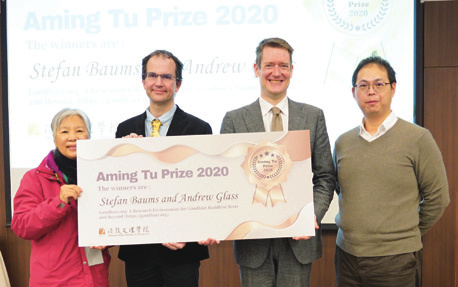
Our heartfelt thanks go out to the award committee and to our wonderful hosts at Dharma Drum. In our acceptance speech, we gave an overview of our work over the last 20 years in building Gandhari.org and the many plans that we have for the future:
Twenty Years
Twenty years ago this year, we began our collaboration on building this website, compiling a complete text and image corpus of Gāndhārī artefacts, and writing our Dictionary, Bibliography, and Catalog. The amount of work involved – both on the content and on the technology supporting it – has at times been staggering, but we trust that the result is both pleasing and useful. We look forward to many more years of improving what we have built, to benefit the flourishing field of Gandhāran studies and to help integrate its findings with the larger disciplines of South Asian and Buddhist Studies.
Year Five Buddha Triad
In June 2021, when the Metropolitan Museum of Art in New York had just reopened after the first wave of the pandemic, I had the opportunity to visit and inspect a very special new arrival: the Year Five Buddha Triad (CKI 232), which had been been sold at auction at Christie’s the year before and is now on loan to the Museum.
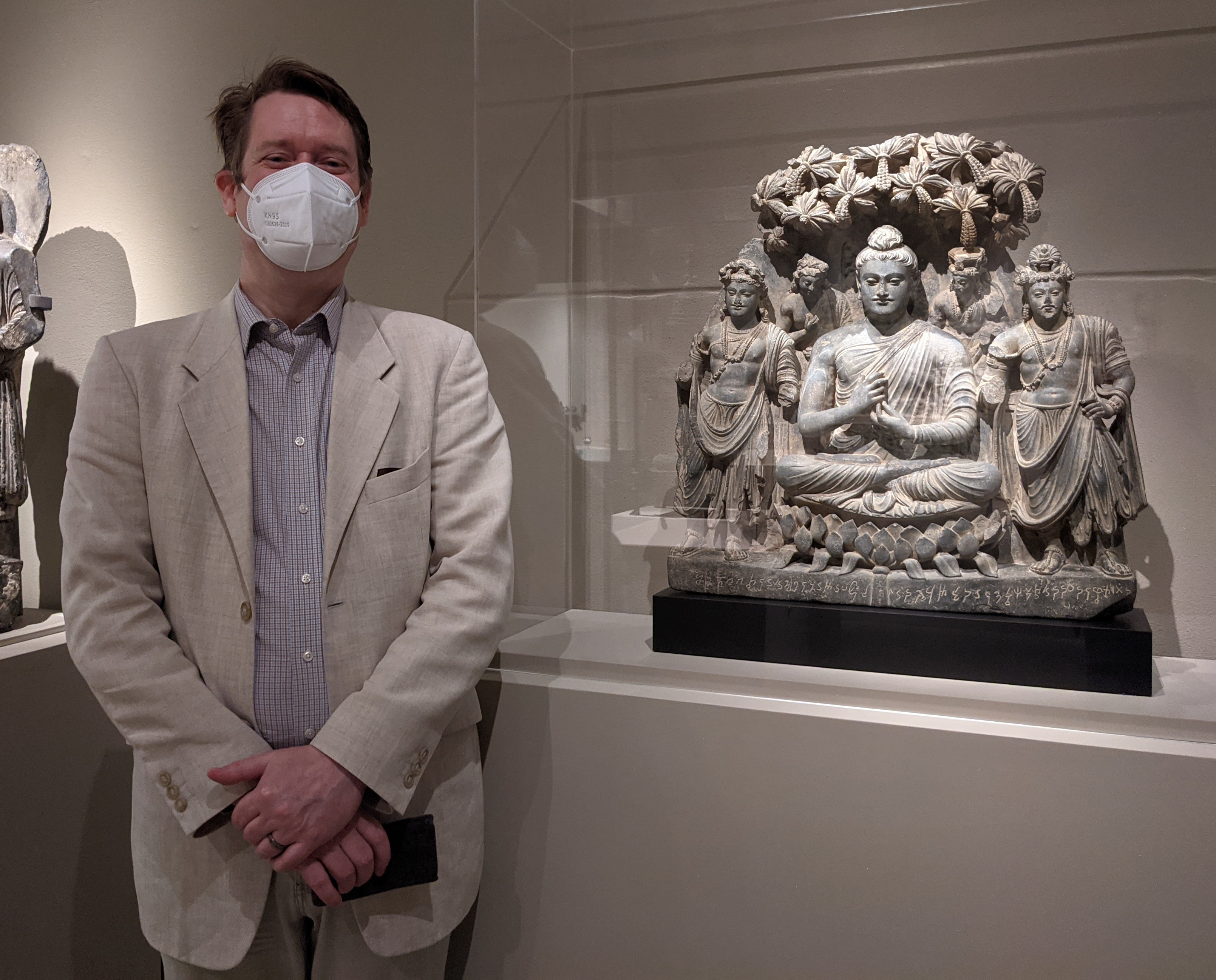
The donative inscription on its base is notable for providing the only attestation in Gandhāra of the Buddhist title trepiḍaga “knowing the three baskets (of the teaching),” i.e., a master of the entire Buddhist canon. When I was in New York again in March 2022, I was very kindly invited to serve as respondent to Juhyung Rhi, who was delivering the Annual Distinguished Lecture on the Arts of South and Southeast Asia to a packed auditorium, in the first event of this scale hosted at the Museum since its reopening. The following is a recording of the lecture, with my remarks on the epigraphy of the Buddha Triad starting at 59:35:
Nine Thousand Articles
Our Dictionary of Gāndhārī has reached 9,000 articles, now with a total of 54,684 references. Article nine thousand is mahajiṭuṃgha, which occurs in a wooden document preserved in the Qinghai Tibetan Medical Culture Museum. This document is a ruling in regnal year 25 of King Aṃgoka. It is the only attestation of maha- ‘great’ with the title jiṭuṃgha ‘palace attendant’ (a Chinese title bestowed on the king of Krorayina). The fact that documents with later dates in the reign of Aṃgoka do not use this title suggests that this may either be a copying error influenced by the use of maha- in other titles for this king (maharaya, mahaṃta), or a temporary claim to a grander title, or perhaps rather that it reflects a more ornate and flattering tone in this one document.
Eight Thousand Articles
Our Dictionary of Gāndhārī has reached 8,000 articles with a total of 41,713 references. Article eight thousand is ñadimitrasalohida, from a fragmentary frieze inscription found at the Taxila Dharmarājika stūpa and wishing for the health of the “relatives, friends and kinsmen” of the donor. The array of compounds expressing the same general notion, attested as early as the Aśokan edicts, is surprisingly large and includes ñadigabaṃdhava, ñadigamitrasaṃbhatiga, ñadigasaṃgha, ñadigasalohida, ñadisalohida, mitrañadigasalohida, mitrañadisalohida, mitramacañadisalohida, mitrasaṃstuda, mitrasaṃstudañadiga, mitrasaṃstudasahayañadiga, savañadiga, savañadisaṃgha. The terms ñadigasaṃgha, savañadisaṃgha and savañadiga suggest that ñadi(ga) is the semantically central element in these compounds, and indeed it is present in all of them with the single exception of mitrasaṃstuda.
Aming Tu Prize
We are proud to announce that we have been awarded the 2020 Aming Tu Prize for Gandhari.org (see also the announcement on the H-Buddhism network). The Aming Tu Prize is bestowed once every three years by the Dharma Drum Institute of Liberal Arts for an “outstanding, creative contribution to Digital Buddhist Studies.”
Website Update
We have updated our website, introducing the new software features that we announced a while ago. One of the immediate benefits of the update is that Dictionary definitions are now displayed in popups when clicking on a word in context; clicking on the heading of the popup opens the full Dictionary article for the lexeme in question. The full-text search function is much improved and now covers all four sections of our corpus at the same time. We have kept the overall, time-tested user interface of the website largely unchanged. The old version remains available at the address gandhari DOT org SLASH azes.
Outline of Gāndhārī Grammar – Updated
Five years ago, I made available an Outline of Gāndhārī Grammar that had grown out of my classes at the University of California, Berkeley, the University of Leiden and the University of Munich. This past July, I updated my Outline for another class that I taught in the Leiden Summer School in Languages and Linguistics. The new version is freshly typeset and now features links from example words into the Dictionary of Gāndhārī that illustrate the range of evidence on which my grammar statements are based. Gāndhārī words are now cited in Dictionary orthography as well as by their reconstructed pronunciation. Like the previous version, this updated version of the Outline is made available under the terms of the CC BY-ND license.